
REVIEW · PORT SHORE EXCURSIONS
Guided Antwerp Port Tour, in your Car or Minibus
Antwerp’s port is so large that the city can disappear behind you while cranes, locks, tanks, rail lines, and ocean ships take over the view. This private drive turns that industrial scale into a story, from Zaha Hadid’s Havenhuis and medieval Oosterweel to the enormous Berendrecht Lock and the old village of Lillo. I like the way the guide connects working machinery with human history, rather than reciting dates. I also like the freedom of using your own car, which lets a small group reach corners that standard city tours miss.
The main drawback is built into the format: you need to provide the car or minibus, and some sights are quick drive-bys rather than long stops. The port is a working industrial zone, so you should expect tanks, roads, fences, noise, and restricted access, not a polished sightseeing route. Still, for anyone curious about how Antwerp actually earns its place on the map, this is an unusually direct look.
Six details that shape the experience
- Havenhuis and the dry docks: Photograph the glass diamond structure above the old fire station and see the dry docks being prepared for a maritime museum.
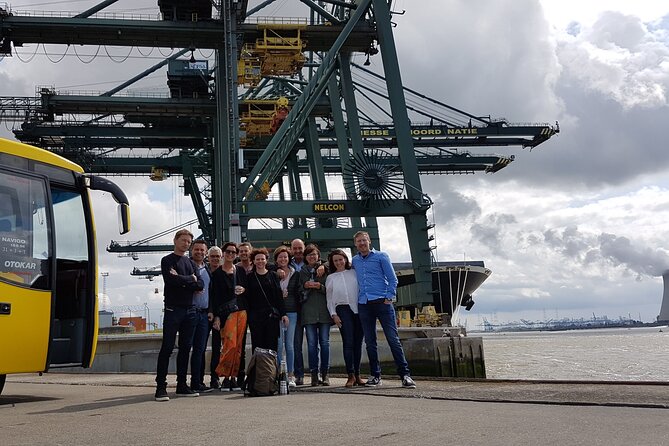
- Europe-scale engineering: Get close to the Berendrecht Lock and watch for giant ships, tugboats, and the machinery that keeps Antwerp’s port moving.
- A medieval village beside industry: Lillo Fort preserves old streets, fishermen’s houses, geese, and a small dock beside one of Europe’s largest chemical clusters.
- A private tour for up to 15 people: Your group travels together in its own car or minibus while the guide boards your vehicle.
- Stories from port specialists: Guides including Laurens and Niki bring local and maritime experience, with Niki noted for more than 40 years in the maritime world.
- A useful value calculation: At $314.42 per group, the price can work well for a full group, but it is less attractive for only one or two people.
Why Antwerp’s port deserves two and a half hours
Antwerp’s historic center is famous for guildhalls, art, and a handsome cathedral. The port tells another part of the city’s story. It reaches far beyond the old quays, stretching through a huge network of docks, roads, pipelines, locks, terminals, and rail connections.
You cover much of this area by car, with short stops where the view rewards getting out. That matters because the port is too broad to understand from one lookout. One minute you are beside a historic building. A few minutes later, you are watching a container crane, a chemical plant, or a lock built for ships hundreds of meters long.
The guide provides the thread connecting these places. You are not simply looking at industrial equipment. You learn how barges, ocean ships, trains, pipelines, fruit terminals, and road traffic fit together. That makes the tour useful for adults interested in engineering, geography, shipping, architecture, and local history. Children aged 12 and older may also find the scale and machinery absorbing, though the experience is less suited to anyone hoping for a relaxed walking tour.
The tour costs $314.42 for a private group of up to 15. I would judge that price by the size of your party. For 10 to 15 people, the cost per person is quite reasonable for a private two-and-a-half-hour outing. For two people, it is a significant expense. Gratuities are included, but you must supply the vehicle.
More Shore Excursions in the world:
- High Speed Harbor Tour from Charlotte Amalie Cruise Port
★ 5.0 · 497 reviews - INVERGORDON PORT Tour of Culloden, Cairns & Cawdor Castle
★ 5.0 · 189 reviews - Busan Cruise Port – Premium Small Group Tour (Max 6 Guests)
★ 5.0 · 173 reviews
Havenhuis and the old dry docks
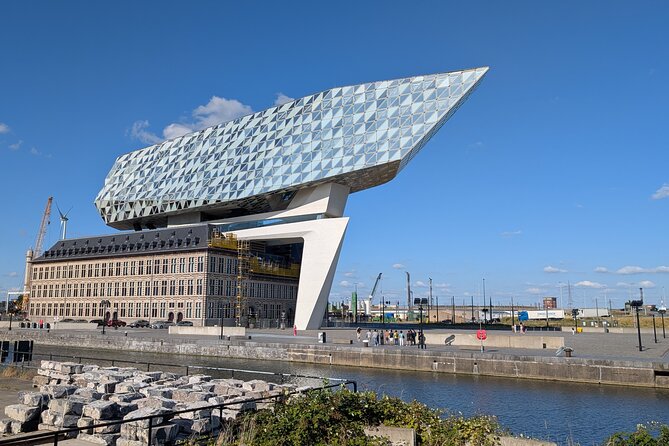
The first stop at Droogdokkenweg introduces the port’s architectural side. You get out opposite Havenhuis, the striking building designed by Zaha Hadid. Its faceted glass upper section appears to rest above a historic fire station, creating a sharp contrast between old masonry and modern geometry.
The view is especially good for photographs. The building catches the light, while the nearby dry docks give the scene a strong sense of place. These old granite basins are being transformed into a maritime museum, so your guide explains how the future project may bring new public life to an area once devoted to ship repair.
You have about 10 minutes here. That is enough for photographs and a clear explanation, but not for a long architectural visit. The attraction is the setting and the guide’s interpretation, not an interior tour of Havenhuis.
Oosterweel, where a church meets a huge construction site
The route then passes Oosterweel, where a small 15th-century church sits beside the enormous Oosterweel construction works. The contrast is hard to miss. A medieval river parish and a massive modern infrastructure project occupy the same view.
The works are being used to cast tunnel sections for the long-awaited closure of Antwerp’s Ring. Your guide links the scene to the city’s growth, post-war expansion, and the need to move traffic around a port that has outgrown its older routes.
This is a drive-by rather than a formal stop. You will not be walking through the construction yard, and the view may change as work continues. Its value comes from the explanation. Without context, you might see a church and a building site. With the guide, you see several centuries of Antwerp’s development compressed into one roadside scene.
Scheldelaan’s chemical plants and graffiti wall
Along Scheldelaan, the car becomes your viewing platform. On one side are storage tanks, processing towers, pipes, and steam. On the other is a long flood wall covered with graffiti created during an international contest.
That pairing gives the route an unexpected bit of color. You see the working side of the port, where pipelines carry materials like hidden arteries, alongside a public art project that breaks up the hard industrial lines.
The guide explains the chemical cluster and its importance to the port. This is not a museum display, and you should not expect to enter the industrial sites. You are looking from public roads while the activity continues around you. For people who want a neat, quiet sightseeing route, this section may feel stark. For anyone curious about modern industry, it is one of the clearest parts of the tour.
More Guided Trips in the world:
- Seattle’s Original Guided Harbor Cruise
★ 4.5 · 2,077 reviews - Rotterdam: Harbor Cruise with Live Guide
★ 4.0 · 1,270 reviews - Seattle: Harbor Cruise with Local Guide
★ 4.8 · 599 reviews - Port Arthur Full-day Guided Tour with Harbour Cruise and Tasman National Park
★ 4.5 · 585 reviews
The Boudewijn and Van Cauwelaert locks
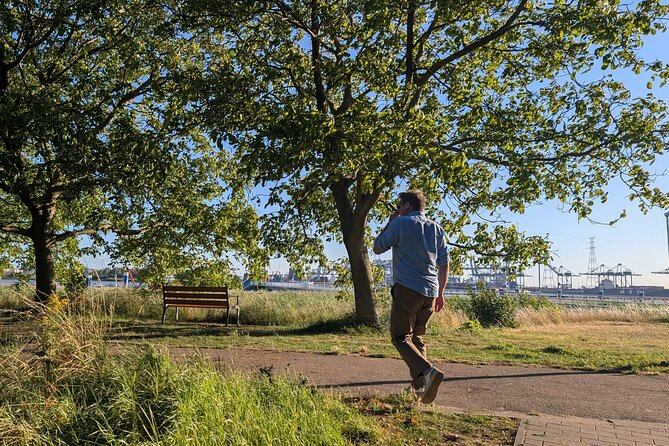
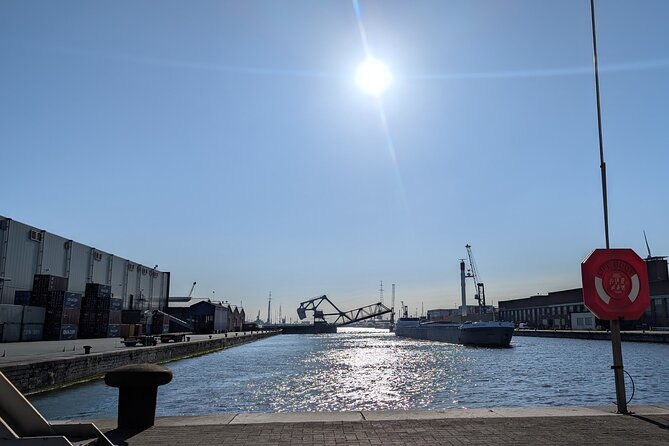
At Boudewijnsluis, you leave the car beside the De Vaarkom basin. The twin locks here are smaller than the giant sea locks later in the route, but they are vital to the port’s daily work. Barges and coastal ships use them, helping move supplies to and from the chemical and refinery areas.
Your guide points out lock-master signals, tug movements, and the turbulence created by bow thrusters. These details help you read the water. A vessel edging through a narrow lock is not just passing through a gate. It is part of a carefully managed sequence of lines, signals, water levels, and engine power.
You have about 10 minutes. It is a good early stop because it teaches you what to watch for before the larger lock scenes arrive. If you happen to see a tug pushing a short-sea freighter into position, the scale feels personal and immediate.
Lillo’s windmill and the port’s vanished villages
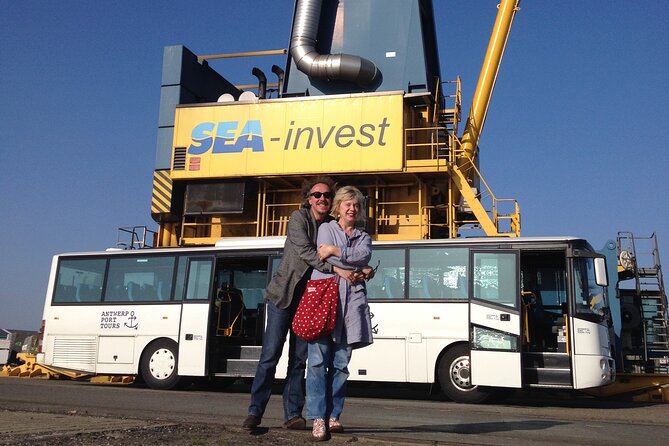
The drive past the old brick windmill near Lillo shows how far the port has expanded. The windmill is a lone reminder of a village landscape that has largely disappeared as docks moved inland.
Your guide explains how some hamlets were purchased and dismantled during port expansion, while some residents resisted leaving. That human detail gives the industrial story a harder edge. Ports create jobs, trade, and wealth, but they also change the places around them.
The stop lasts about 10 minutes. You may not get a long walk here, but the view works as a marker of distance. After many kilometers on the road, you are still only partway through the port. That fact alone helps you understand Antwerp’s size better than a number on a map.
Berendrecht Lock and the scale of ocean shipping
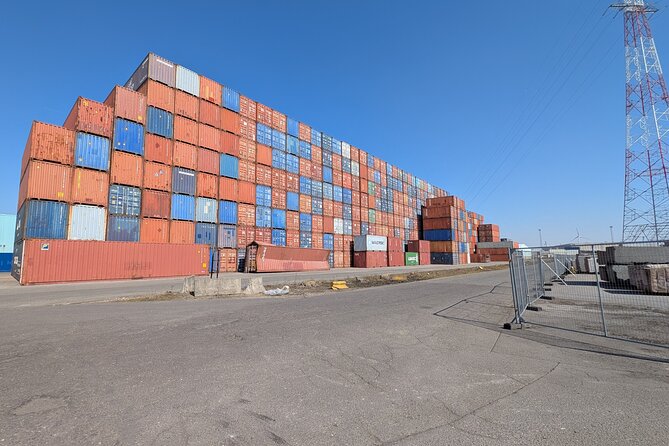
The Berendrecht Lock is one of the route’s main highlights. From the service road, you look toward one of the world’s largest sea locks, a gateway to the docks beyond.
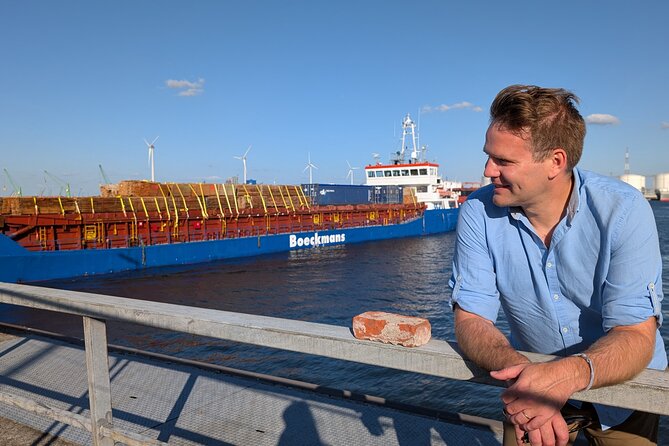
Your guide shares the measurements and explains the work of tugboats and line-handlers. If timing is good, a very large bulk carrier or container ship may be moving through. From beside the road, the hull can feel more like a wall than a boat.
There is no guarantee that a ship will be passing during your visit. That is important to keep in mind. Even without live action, the lock’s size gives the stop weight. With a vessel in motion, it becomes one of those memorable port scenes that is difficult to reproduce from a city viewpoint.
Dock 910 and four views at once
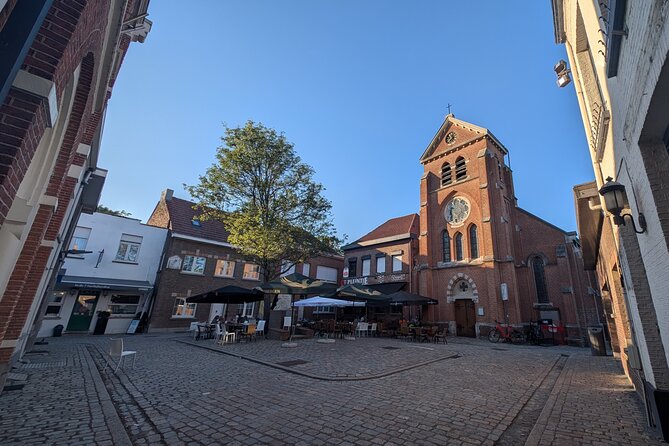
At the Dock 910 riverside overlook on Zandvlietweg, you get out close to PSA’s container quays. Straddle carriers move between stacks, and rows of cranes load and unload ships along the river.
Your guide uses this one location to point out several parts of the wider region. You can see the Berendrecht and Zandvliet locks, the Belgium-Netherlands border running through the river, and the cooling towers of the Doel nuclear plant in the distance.
This is a particularly good stop for understanding how packed the port’s functions are. Container handling, international borders, nuclear energy, and sea access all appear in one broad view. Allow around 10 minutes. Bring your attention to the moving details, since the machinery can be more interesting than the static structures.
Lillo Fort, old streets beside chemical towers
Lillo Fort changes the mood completely. The car leaves the industrial roads and enters an old settlement with cobblestones, grassy ramparts, 18th-century fishermen’s houses, and a small dock.
Geese wander around the fort, and cafés add a touch of ordinary village life. Your guide brings in stories of Spanish sieges, smugglers, and residents who kept their community alive beside the expanding port.
This is the longest stop, at about 30 minutes, and it deserves the extra time. You can get out, walk around, and absorb the odd balance of the place. Across the dike, chemical stacks rise above the old houses. The result is not pretty in a traditional postcard sense, but it is memorable and honest. Antwerp’s past has not been cleared away entirely. It remains beside the industry.
Lillo may be the best stop for visitors who want more than machinery. It gives the port a human scale and shows what existed before the docks reached this far.
Antwerp-North rail yard and the final container route
The tour continues past Antwerp-North Hump Yard, a large rail marshalling area. From the car, you look down on a web of tracks where as many as 1,000 wagons may be rearranged in a day.
Your guide explains the hump-yard process. Locomotives push mixed trains up a raised section. Wagons roll downhill, then sensors, retarders, and computer-controlled switches direct them into new trains bound for places such as Germany, France, and the Ruhr.
This is another drive-by, so the experience depends on timing and visibility. If wagons are being sorted, the sound and motion make the process fascinating. If the yard is quiet, the explanation still shows how rail completes the port’s network. Ships bring goods in, roads distribute them, and trains carry freight inland.
The final section at Lubeckweg takes you through rows of stacked containers. Granite blocks await export on one side, while refrigerated container racks serve Europe’s largest fruit terminal on the other. Bananas and citrus can move from ship to supermarket in a short chain of handling and transport.
You spend about five minutes here, so it is a brisk finale. Look closely at the different container colors and the equipment moving between them. This is the closest the tour comes to placing you inside the port’s daily machinery, even though you remain on the vehicle route.
What the private format means for you
This is a private activity for your own group, with a maximum of 15 people. The guide boards your coach or minibus, but the vehicle itself is not included. A car works for a small group, while a minibus makes more sense for a larger party.
That arrangement gives you control over who travels together and keeps the commentary focused on your group. It also means you should confirm your vehicle plan before booking. The meeting point is Kinepolis Antwerpen on Groenendaallaan 394, and the tour returns there.
The experience is offered in English. Guides such as Laurens have been praised for making the port feel conversational rather than turning the trip into a list of facts. Niki is noted for multilingual guiding and more than 40 years of maritime experience. If a particular guide or language matters to you, check availability before you pay.
Most people can take part, and service animals are allowed. The tour is not recommended for people with serious respiratory diseases, given the amount of time spent near an active industrial zone. The suggested minimum age is 12.
Who should book this port tour?
I would book this if you have already seen Antwerp’s old center and want to understand the city’s working side. It suits people interested in ships, railways, construction, architecture, industrial design, local history, and large-scale engineering.
Families with older children can find plenty to watch, especially at the locks and rail yard. A group celebrating a birthday or planning a private outing may also get good value from the vehicle-based format. The personal stories and unexpected stops make it more engaging than a standard sightseeing loop.
I would skip it if you want a walking tour, indoor attractions, or guaranteed close-up access to ships and machinery. Much of the route is viewed from the car, and port operations cannot be scheduled around your visit. Weather matters too. The activity requires good weather, and poor conditions can lead to a new date or a full refund.
Free cancellation is available up to 24 hours before the start time. Changes or cancellations made within 24 hours are not accepted for a refund.
Should you book it?
Book this tour if you want to see the Antwerp most city visitors miss: the dry docks, chemical works, locks, freight trains, container yards, and the stubbornly preserved village of Lillo. Its strongest feature is the guide’s ability to make all those separate sights part of one understandable story.
The best value comes with a larger group and a suitable car or minibus. For a small party, compare the price carefully. If you accept a few drive-bys and unpredictable port activity, you get an unusual, well-focused look at the systems that keep Antwerp connected to Europe and the world.
FAQ
Where does the Antwerp port tour start?
The tour starts at Kinepolis Antwerpen, Groenendaallaan 394, 2030 Antwerpen, Belgium.
Where does the tour end?
The activity ends back at the starting meeting point.
How long does the tour last?
The tour lasts approximately 2 hours and 30 minutes.
Is transportation included?
No. You must provide the car, coach, or minibus. The guide boards your bus or travels in your vehicle during the tour.
How many people can join the private tour?
The private tour allows up to 15 people in your group.
What language is offered?
The tour is offered in English. Guides with additional language skills may be available, but you should confirm this when booking.
Is the tour suitable for children?
The advised minimum age is 12. Most people can participate, but the tour is not recommended for anyone with a serious respiratory disease.
Can I cancel for a full refund?
Yes. You can cancel at least 24 hours before the local start time for a full refund. If poor weather causes the provider to cancel, you will be offered another date or a full refund.
New on the water in the world
- Around the Bay Sightseeing and Bay Cruise★ 5.0 · 24 reviews
- Luxury Harbour Ocean Boat Cruise★ 4.5 · 14 reviews
- Galveston Historical Harbor Tour – Maritime & Heritage Cruise★ 4.5 · 29 reviews
- Unrivalled Coastal Tour to Saint’s Bay Harbour★ 4.5 · 29 reviews
- Private Hamad Port Tour in Mesaieed |Aquarium |Maritime Museum★ 5.0 · 3 reviews
- Amber Cove and Taino bay Cruise Ship – Waterfalls of Damajagua★ 4.0 · 9 reviews
- Montenegro Bay Cruise with Lunch on the Boat day trip★ 4.0 · 21 reviews
- Monday & Thursday Nights Harbor Lights Tiki Tour★ 4.5 · 10 reviews
Port Shore Excursions, compared.
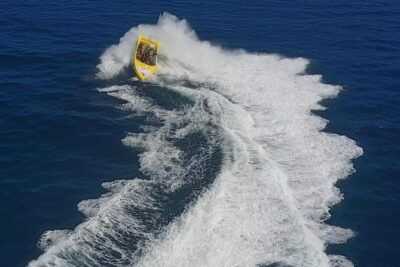
High Speed Harbor Tour from Charlotte Amalie Cruise Port
Read our review →
INVERGORDON PORT Tour of Culloden, Cairns & Cawdor Castle
Read our review →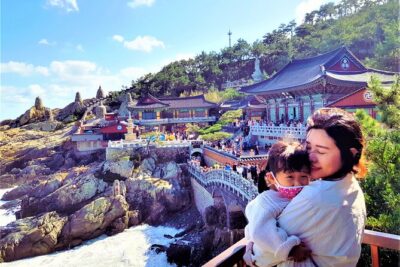
Busan Cruise Port – Premium Small Group Tour (Max 6 Guests)
Read our review →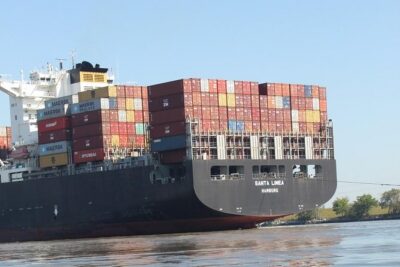
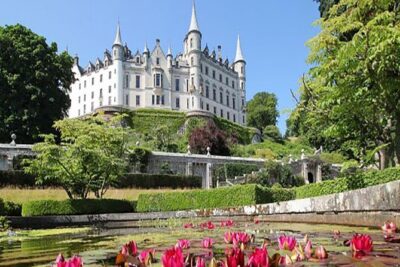
INVERGORDON PORT Tour Dunrobin, Dornoch & Distillery
Read our review →
Doha City Souq Waqif Katara Pearl Qatar and Old Doha Port Tour
Read our review →
Browse the lists this tour appears in